Many growers say the same thing today: “Under HPS it basically grew by itself, but with LEDs something is always off.” This isn’t nostalgia or forum folklore. Modern LED lights are more efficient, cheaper to run, and technically superior — but they also expose every weakness in a grow setup. This article isn’t about blaming LEDs. It explains why old habits stop working once you switch to modern lighting.
It really was easier before
Traditional HPS lamps (high-pressure sodium) had one major advantage that is often forgotten today: they heated the air strongly. The entire room stayed warm, humidity dropped naturally, and plants transpired easily. Water and nutrient uptake often worked even when conditions weren’t ideal.
LEDs changed this balance. They deliver a lot of usable light, but they do not raise air temperature the way HPS did. This is where problems begin for growers who try to run LEDs the same way they ran older systems.
LEDs don’t heat the air — but they heat the leaf
This is one of the most misunderstood aspects of LED lighting. The grower checks the thermometer: 23–24°C, everything looks fine. Meanwhile, the leaf surface temperature is noticeably higher.
Why does this happen?
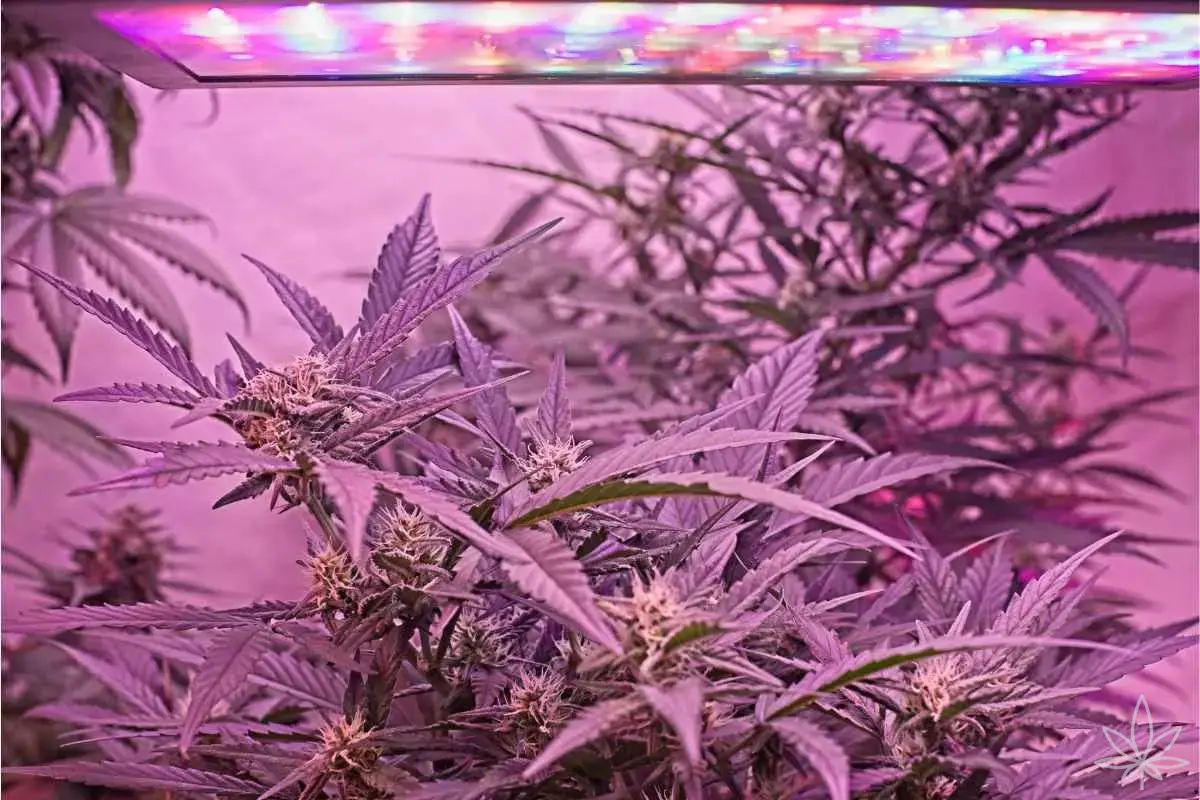
LEDs deliver light energy in a very concentrated, directional way. The leaf absorbs photons, photosynthesis ramps up, and the leaf heats locally, while the surrounding air remains relatively cool and often too humid. This creates a conflict:
– the leaf wants to transpire strongly,
– the air does not allow it,
– the plant starts protecting itself.
The result is familiar: tacoing (leaf edges curling upward), canoeing (boat-shaped leaves), deformation and light/heat stress, even though “the room temperature is correct.”
PPFD vs “bright light” — why lumens don’t matter
One of the biggest LED-era misconceptions is judging grow lights by lumens. Lumens describe brightness as perceived by the human eye, not how much usable energy reaches the plant.
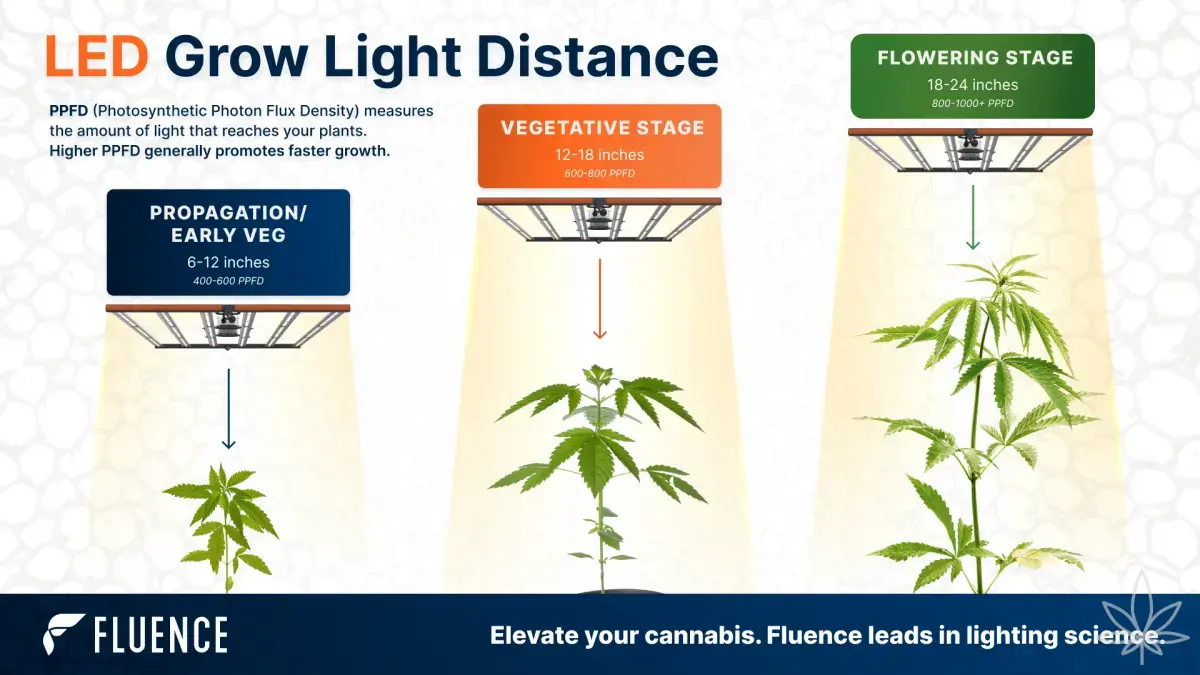
Plants respond to PPFD — Photosynthetic Photon Flux Density. In simple terms, PPFD measures how many photosynthetically active light particles actually hit one square meter of leaf area per second.
LEDs can show modest lumen numbers while delivering very high PPFD, easily overloading photosynthesis if airflow, humidity, and temperature are not properly matched.
HPS light was more diffuse and forgiving. LEDs create a dense, even photon field. This is a major advantage — but only if the grow environment keeps up.
LEDs and Cal-Mag: myth, half-truth, and reality
A common statement online is: “LEDs cause Cal-Mag deficiencies.” This needs clarification.
LEDs do not magically remove calcium (Ca) or magnesium (Mg). What they do is increase the plant’s reliance on efficient transpiration. Calcium and magnesium are nutrients whose movement inside the plant depends heavily on proper water flow.
When transpiration slows, Ca and Mg delivery fails first. Symptoms look like deficiencies even when nutrients are present in the medium. This leads to confusion and constant supplementing.
Sometimes adding Cal-Mag helps — but only when the underlying problem is still mild. If the issue is environmental rather than nutritional, adding more product does not fix the cause.
Why LEDs punish VPD mistakes faster than HPS
VPD stands for Vapor Pressure Deficit — the difference between how much moisture air can hold and how much it already contains. In practical terms, it describes whether a plant can release water through its leaves.
Under HPS, high air temperature masked many mistakes. With LEDs, tolerance is much lower:
– humidity too high → the plant doesn’t drink,
– air temperature too low → transpiration slows,
– strong light without airflow → leaf overheating.
LEDs reveal these problems very quickly, often within 24–48 hours. This is why many growers feel that LEDs “cause issues,” when in reality they simply stop hiding them.
Why the same nutrient recipe no longer works
This is a common shock after switching from HPS. Same fertilizer, same dosage, same pH — different results.
The reason is straightforward: under LEDs, photosynthesis speed, water uptake rhythm, and stress sensitivity change. Feeding levels that were safe under HPS can now be too aggressive or poorly matched to actual uptake.
It’s not that the nutrients are worse. It’s that the environment no longer compensates for mistakes.
LEDs are not the problem
Modern grow lights don’t damage plants by themselves. They expose weaknesses in watering practices, humidity control, airflow, and reliance on outdated routines.
Growers who understand how LEDs interact with plant physiology gain far more control than they ever had before. Those who try to run LEDs “the old way” usually end up chasing symptoms.
Conclusion
If growers say things were easier before, they’re often right — but not because LEDs are inferior. Older systems tolerated imperfect conditions. LEDs do not. They require better environmental control and more precise decisions.
Understanding this difference is the key to stable, predictable results under modern lighting.