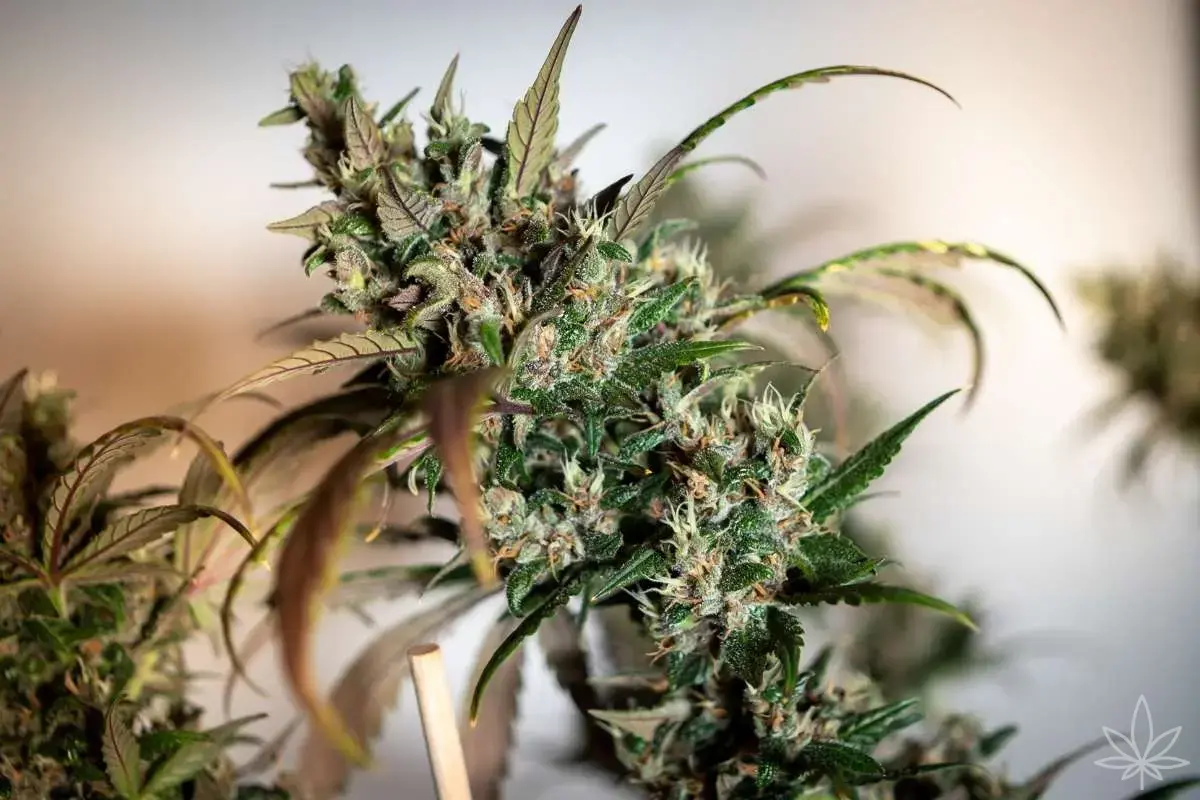
This is one of the most frustrating moments in the entire grow cycle. For weeks everything looked right: steady growth, healthy leaves, no obvious deficiencies, and an increasingly promising aroma during flower. Then harvest day comes. You pick up a bud — and something feels off. It’s light. Soft. Airy. Lacking that dense, solid weight you were expecting.
The first thought is almost always: “That’s just the genetics.” The second: “That’s how LEDs grow.” Both are convenient explanations — and in most cases, both are wrong. Fluffy buds are not bad luck or coincidence. They are the result of very specific environmental conditions that can be understood and — more importantly — fixed.
Fluffy Buds Are a Diagnosis, Not a Verdict
Loose flower structure is not an aesthetic flaw or a genetic curse. It is direct feedback from the plant, saying: “I flowered, but I didn’t have the conditions to finish building mass.” This distinction is critical, because many growers confuse flowering itself with effective biomass production.
A plant can:
- produce pistils,
- smell intense,
- look visually healthy and green,
and still fail to densify its flowers. Dense buds don’t appear automatically. They are the result of a long, stable metabolic process where light, transpiration, temperature, and nutrition work together — for many weeks — without constant disruption.
LEDs Changed the Rules (and Many Growers Didn’t Notice)
For years, HPS lighting masked many mistakes. It heated aggressively, dried the air, and blasted energy from a single point. LEDs work differently. They’re cooler, more even — and far less forgiving of simplifications.
The most common problem isn’t that there’s “too little” or “too much” light. It’s that:
- energy doesn’t reach the flowers effectively,
- the canopy isn’t uniform,
- PPFD in the bud zone is insufficient for too long.
Under LEDs, a plant can look great visually while never operating at full photosynthetic capacity. And without surplus energy, there is simply nothing to build dense flowers from. The result is buds that look decent on the plant but feel hollow once harvested.
Bud Density Is Built Through Transpiration, Not Fertilizer
This is where one of the most ignored topics comes in: VPD. Many growers know the term from charts but fail to connect it directly to flower quality. In reality, VPD determines how fast the plant can work.
Without proper transpiration:
- water transport slows,
- nutrient movement drops,
- metabolic intensity never peaks.
What to do, step by step:
- Target leaf temperature, not air temperature. LEDs don’t heat leaves like HPS, so air temps often need to be higher than expected.
- Match humidity to temperature, instead of holding a fixed RH “by feel.”
- Avoid sharp day–night swings. Sudden VPD changes slow metabolism precisely when flowers should be densifying.
When VPD is off, the plant doesn’t crash or show dramatic symptoms. It simply never fully commits to building mass.
Nitrogen in Flower: The Silent Saboteur of Dense Buds
Excess nitrogen during flowering is one of the most common — and least obvious — causes of fluffy buds. Nitrogen doesn’t damage the plant in a dramatic way. Quite the opposite: it often makes the plant look “healthy.”
But that health is deceptive. Too much nitrogen:
- keeps the plant in vegetative mode,
- prioritizes leaves over flowers,
- delays generative tissue maturation.
What to do:
- Reduce nitrogen gradually, not abruptly — the plant must transition, not panic.
- Watch leaf structure, not just color. Excess nitrogen often shows as softness, not dark green.
- Shift focus to potassium and phosphorus in mid-to-late flower, instead of maintaining lush foliage.
If nitrogen dominates too long, flowers develop — but never harden structurally.
Late Flowering: Where Most Growers Undo Everything
The final 2–3 weeks are when bud structure is completed — and also when growers are most likely to interfere.
What NOT to do:
- don’t cut nutrients abruptly “because it’s time,”
- don’t perform aggressive early flushes,
- don’t suddenly reduce light intensity.
What TO do:
- Keep conditions stable until the end. The plant needs continuity to finish building tissue.
- If you flush, do it gently and briefly, not as a system reset.
- Harvest when the flower is structurally finished, not when the calendar says so.
Fluffy buds are often the result of ending the process too early, not mistakes made at the start.
Night Temperature and the “Cool Nights” Myth
Cool nights are trendy — but misused, they stall metabolism.
What to do:
- limit night temperature drops,
- introduce cooler nights only at the very end,
- never sacrifice metabolic continuity for aesthetics.
If the plant is “shut down” at night, the day can’t compensate.
Why It’s Almost Never Genetics
Yes, some cultivars naturally produce looser flowers. But if:
- different strains produce similarly fluffy buds,
- the problem repeats grow after grow,
- other growers get dense buds from the same genetics,
then the answer is clear: genetic potential was never reached. Genetics set the limits. Conditions decide how close you get to them.
How Experienced Growers Think
Experienced growers don’t hunt for “dense-bud strains.” Instead, they ask:
- were conditions stable,
- was the plant constantly adjusted,
- did it receive enough time and energy to finish the cycle?
Because bud density is the result of patience and consistency, not aggressive control.
The maryjane.farm Grower’s Summary
Fluffy buds aren’t bad luck and they’re rarely “just genetics.” They are the outcome of specific environmental decisions that can be identified and corrected. Growing cannabis isn’t about constantly fixing the plant — it’s about creating conditions where the plant can finish its work uninterrupted.
maryjane.farm doesn’t chase hacks.
maryjane.farm teaches stable, conscious cultivation, where dense buds are a natural result — not a gamble.
🛠️ BOX 1
Repair Checklist: What to Fix When Your Buds Are Light and Fluffy
If your buds are airy, go through this entire list in order. Not selectively. Fluffy flowers are almost always the result of multiple small issues, not one big mistake.
LIGHT
- Is the canopy even, with all tops at similar height?
- Did buds receive sufficient light throughout most of flowering — not just a “safe” amount?
- Did you avoid raising the fixture unnecessarily during flower?
VPD / CLIMATE
- Was leaf temperature adjusted for LED conditions (often higher than HPS setups)?
- Was humidity stable, without large day–night swings?
- Did the plant transpire actively rather than conserving energy?
NUTRITION
- Was nitrogen clearly reduced after early flower, instead of being maintained “for color”?
- Was potassium prioritized in mid-to-late flower instead of continued vegetative feeding?
- Was EC stable, without sudden drops?
LATE FLOWER
- Did you avoid flushing too early or too aggressively?
- Did you keep light intensity stable until the end?
- Did you allow the plant to finish building flower mass?
NIGHT TEMPERATURE
- Was the night temperature drop moderate, not extreme?
- Were cool nights introduced only at the very end?
👉 If more than two answers are “no” or “not sure” — you’ve found the cause of fluffy buds.
🧭 BOX 2
Decision Path: Where to Look First for the Cause
Instead of checking everything at once, follow this exact order. This is how experienced growers troubleshoot.
STEP 1 – LIGHT
➡️ If buds were underlit or the canopy uneven
→ stop here.
Fix lighting first. No energy = no density.
STEP 2 – VPD / TRANSPIRATION
➡️ If transpiration was weak
→ flowers had no material to build mass.
Fix climate before touching nutrients.
STEP 3 – NITROGEN
➡️ If the plant stayed lush and green until the end
→ it likely never switched fully into reproductive mode.
Reduce nitrogen at the right time — not sooner, not later.
STEP 4 – LATE FLOWER MANAGEMENT
➡️ If flushing was early or aggressive
→ flower construction was interrupted.
Stability beats “clean conscience.”
STEP 5 – NIGHT TEMPERATURE
➡️ If nights clearly shut the plant down
→ days couldn’t compensate.
Density requires metabolic continuity.
ONLY AT THE END – GENETICS
➡️ If everything above was correct
→ only then consider genetic influence.
Before that, it’s a distraction.
⚠️ BOX 3
MOST COMMON MISTAKES THAT COME BACK EVERY GROW (EVEN FOR EXPERIENCED GROWERS)
These are not classic “beginner mistakes.” These are recurring patterns of thinking and action that return even among growers with several successful runs behind them. And it is exactly these habits that most often lead to light, unfinished, fluffy buds.
❌ “THE PLANT LOOKS HEALTHY, SO EVERYTHING IS FINE”
This is one of the most misleading mental shortcuts. A plant can be green, spotless, free of visible deficiencies, smell great — and still be operating far below its real production potential.
A healthy leaf appearance:
- says nothing about photosynthetic intensity,
- does not guarantee proper transpiration,
- does not mean the flowers are actually densifying.
➡️ HOW TO FIX IT:
Start evaluating the working pace of the plant, not just how it looks. Observe whether flower mass is truly increasing week by week, instead of focusing only on leaf color.
❌ “I’LL ADD MORE NUTRIENTS — MAYBE SOMETHING IS MISSING”
This is one of the most destructive reflexes in cultivation. When bud density is the issue, adding more nutrients almost always makes things worse, because the cause rarely lies in a real nutrient deficiency.
Most often, the real problem is:
- poor transpiration,
- incorrect VPD,
- insufficient light energy,
not a lack of nitrogen, phosphorus, or potassium.
➡️ HOW TO FIX IT:
First, correct uptake conditions (climate, light, stability). Only then consider nutrient adjustments. The plant cannot use what it is physiologically unable to absorb.
❌ CONSTANT “MICRO-ADJUSTMENTS” OF PARAMETERS
Small daily changes:
a bit of humidity, a bit of EC, slightly raising the light, a minor temperature tweak. Each one seems harmless on its own, but together they break metabolic continuity.
Instead of building mass, the plant:
- constantly adapts,
- loses its working rhythm,
- never enters a stable production mode.
➡️ HOW TO FIX IT:
Make changes less often, but deliberately. Adjust one parameter and give the plant several days to respond. Stability always beats perfect knob-twisting.
❌ TREATING LATE FLOWER AS A “SHUTDOWN PHASE”
A very common mental mistake. The final weeks are treated as a formality:
flush, waiting, counting days to harvest. Meanwhile, this is exactly when flower structure and mass are being built.
Letting go too early:
- interrupts biomass accumulation,
- results in light, immature buds,
- creates a false sense of a “well-managed grow.”
➡️ HOW TO FIX IT:
Think of late flowering as the most important quality phase, not as a shutdown procedure. This is not the epilogue — it is the climax.
❌ INTRODUCING COOL NIGHTS TOO EARLY “BECAUSE THAT’S HOW IT’S DONE”
Lowering night temperatures halfway through flowering is a classic example of blindly copying patterns. In practice, it slows metabolism exactly when it should be at its peak.
The result:
- lower enzymatic activity,
- slower mass accumulation,
- buds that “never fully packed on weight.”
➡️ HOW TO FIX IT:
If you use cooler nights, introduce them only at the very end, as a subtle finishing touch — not as a tool for building flower mass.