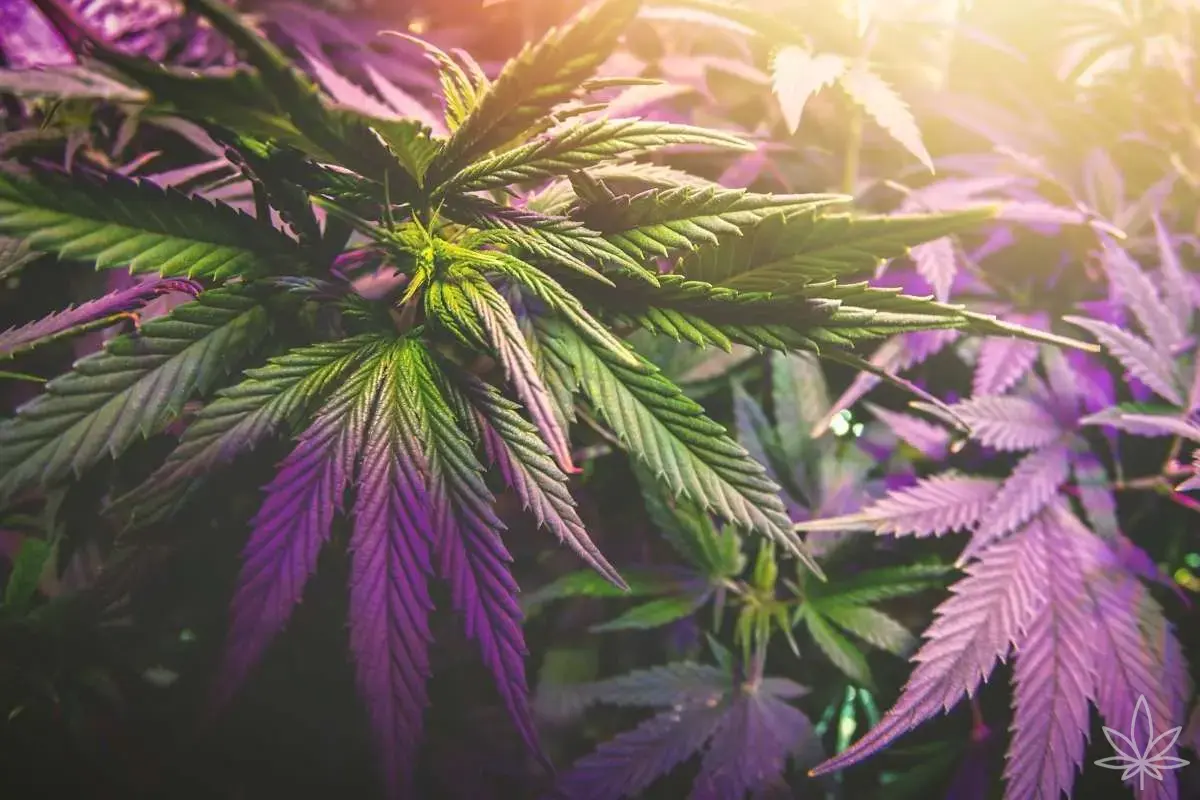
In the world of indoor growing, you often hear the phrase “the more light, the better.” And sure, it makes sense – light is the fuel for photosynthesis, and the more energy we give to the plant, the stronger it grows. But is there really a point where there’s just too much light? Today we’ll break down the concept of “light stress” and figure out where the benefit ends and the problem begins.
Photosynthesis and the Limits of the Plant
Every cannabis plant has its own limit of light absorption – known as the photosynthetic saturation point (PPFD saturation point). Up to a certain level, the more light it receives (measured in micromoles of photons per square meter per second, or µmol/m²/s), the faster photosynthesis happens and the plant produces more energy. But once it crosses that threshold – usually around 1000–1200 µmol/m²/s for most strains – efficiency begins to drop.
It’s a bit like eating food – one burger gives you energy, a second one still goes down, but by the fifth your stomach says stop. Same with the plant: instead of growing faster, it starts to react with stress.
Symptoms of Too Much Light
What happens when your girl gets blasted with too many photons?
- Leaf “clawing” and “tacoing” – leaf edges curling upwards, forming a taco shape. It’s a defense mechanism to reduce the surface area exposed to light.
- Chlorosis (leaf bleaching) – tops turn light green, almost yellowish, because chlorophyll breaks down under excess light.
- Light burn – characteristic brown spots on leaves without direct contact with the lamp (different from heat stress).
- Slowed growth – paradoxically, instead of speeding up, metabolism slows as the plant puts its energy into defense rather than development.
PPFD and DLI – How Much Light is Really Needed?
Indoor growers often use PPFD meters (Photosynthetic Photon Flux Density). They tell us how many photons actually hit the canopy. But in practice, DLI (Daily Light Integral) – the total amount of light delivered over a day – is even more important.
- In vegetative phase cannabis is happy with a DLI of 20–30 mol/m²/day, which equals 400–600 µmol/m²/s at 18 hours of light.
- In flowering phase you can push it up to a DLI of 35–45 mol/m²/day, which equals 700–1000 µmol/m²/s at 12 hours of light.
Above these levels, you risk diminishing returns – more watts from the socket, but not necessarily more THC in the buds.
LED vs HPS – Different Light Profiles
- HPS (high-pressure sodium) lamps give plenty of light, but also a lot of heat. In this case, temperature usually becomes a problem before photon overload does.
- LEDs are more efficient but can “overcook” plants because they produce an intense light beam from close range. It’s very easy to overdo it if you hang the lamp too low.
How to Avoid Light Stress
- PAR meter – the best investment a grower can make. For around €150–200 you can get a simple quantum sensor to measure what really hits the canopy.
- Proper lamp distance – manufacturers provide recommendations (e.g., 30–40 cm for most LED panels). Stick to those and watch your plants’ reactions.
- Plant training – LST, topping, SCROG – spreading out the canopy ensures every part gets enough light without burning the tops.
- Gradual light increase – instead of blasting 100% power from day one, start at 60–70% and increase weekly.
The Cost of “Too Much Light”
It’s not just stress for the plant, but also for your wallet. Running lamps at full power means higher energy bills. For example:
- A 300 W LED panel running 18 h/day in veg consumes about 48.6 kWh/month, which at an average of €0.25/kWh costs about €12/month.
- If you boost it to 450 W “just in case,” but the plant can’t even use the extra light, you’ll pay an additional €6–7 per month... for nothing.
FAQ – Frequently Asked Questions
Does more light always mean more THC?
No. THC depends not just on light, but also genetics, temperature, nutrition, and stress. Too much light can even lower bud quality.
How do I tell heat stress from light stress?
If the damage appears only on the top leaves closest to the lamp, it’s usually light stress. If the whole plant looks “tired,” the issue is more likely heat.
Is CO₂ supplementation worth it under high light intensity?
Yes – plants with added CO₂ (1200–1500 ppm) can use higher PPFD levels without stress. But that’s more of an advanced grower move.
Yes, you can definitely have too much light in indoor growing. The limit isn’t always obvious, as it depends on genetics, environment, and the type of lamp, but the general rule is: more is not always better. The key is balance – giving the plant as much energy as it can actually process, without wasting money on unused photons.