When I first saw vertical grows in professional facilities, I thought: “Unbelievable — these guys are pulling two or three times the yield from the same volume.” A few years later the technology became cheap enough that home growers also started experimenting. And you know what? It really works — but only if you control the climate fully and do not rely on “it will probably work.” Vertical and multi-layer home growing is not for complete beginners, but if you already handle a normal tent confidently, you are just one step away from doubling what you harvest per square meter. In this article, I will show you how it looks in practice: which equipment you need, how much it costs, what the real traps are and how to do it without turning your apartment into a hot box with leaves stuck to the walls.
Vertical cannabis growing is not new, but only in the last 3–4 years has it become accessible for home growers. Before that, you needed lighting that would not burn plants from the side and still deliver decent PPFD. Old HPS lamps were completely unsuitable — they roasted leaves like popcorn. Modern LED panels with evenly distributed diodes finally made it possible to run plants on two levels without torching them.
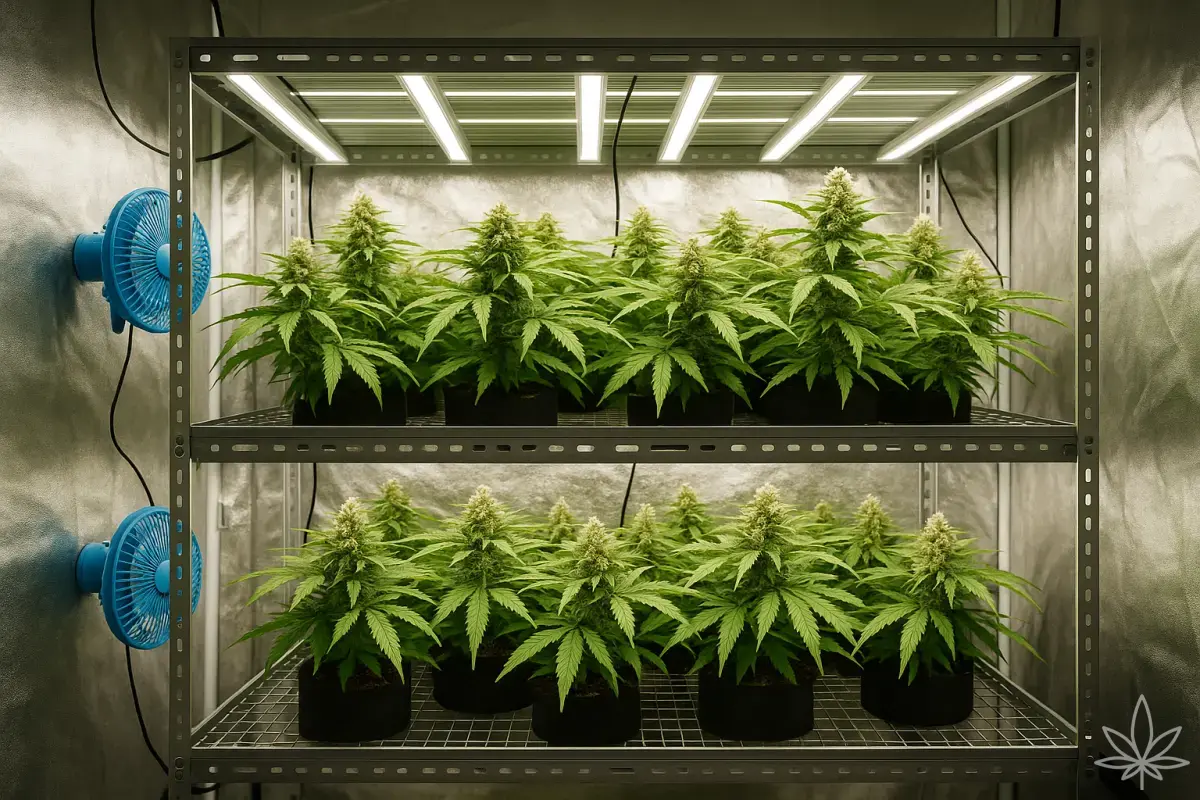
In 2025 growers use two general approaches: vertical SOG (plants arranged in a circle around a central light source) or multi-layer shelving systems, meaning classic shelves with lighting above each tier. The second method is far easier in home conditions — and that is the one we focus on.
1. What Does Multi-Layer Actually Give? Real Numbers, Not Reddit Dreams
With a single layer in a 120×120 cm tent, most growers achieve 350–550 g of dry flower under good LEDs. That is a fair result. But when you add a second tier — and control the climate — you can pull 700–900 g, and some growers even report 1.1 kg.
Is this magic?
No — it is simply doubling the vegetative surface. Plants do not run on spells; they run on photosynthesis. Two layers of light = twice the leaf surface. That is all.
But for it to work you must:
- keep temperature stable between tiers,
- control VPD properly,
- choose suitable genetics,
- prevent humidity spikes (very common in two-tier systems),
- ensure constant air movement.
Sounds serious? Because it is. But once the climate is under control, multi-layer turns into a yield machine.
2. The Most Important Element — Light That Does Not Burn and Does Not Cheat
In standard grows most LEDs provide 800–1000 µmol PPFD in the center and less on the edges. With two levels you cannot allow hotspots. You need panels that:
- have very even photon distribution,
- do not produce excessive heat under the panel,
- offer good efficiency (2.6–3.0 μmol/J),
- can be dimmed properly.
A typical multi-layer setup uses:
- a 240–320 W panel on the upper tier,
- a 200–240 W panel on the lower tier (because distance to canopy is smaller).
A good LED panel costs 180–350 EUR. For two levels, expect 350–600 EUR just for lighting.
Is it worth it? If maximum grams per square meter are your goal — absolutely.
3. Climate Stability — the Key to Success (and the Main Source of Failure)
Imagine a 120×120 cm tent divided into two floors. The upper level warms nicely from the lamp, while the lower level accumulates humidity because cooler air sinks. Without proper air movement you create perfect mold conditions.
The key parameters you must hold steady:
- upper temperature: 25–27°C,
- lower temperature: 23–25°C,
- humidity: 50–60% in flowering, 60–70% in veg,
- VPD: consistently between 1.0 and 1.3.
This is where VPD shows its true power — when tiers differ, plants react with stress. That is why you should invest in two temperature-humidity sensors (one per level). A good sensor costs 20–40 EUR.
Extra tip: direct airflow so that it gently “pushes” air between tiers rather than mixing in one stagnant pocket.
4. Construction — Shelves, Frames and Safety
You cannot simply place pots on a random IKEA shelf. Multi-layer requires a stable structure:
- metal shelving with minimum 50 kg load per tier,
- shelf spacing 40–60 cm (depending on genetics),
- mounting points for LED panels on each tier,
- at least one circulation fan per level.
A good metal rack costs 75–150 EUR. Add 20–40 EUR for straps and hooks for the LEDs.
A common beginner mistake: installing the panel too close to the plants. At 20–25 cm distance most modern LEDs will burn tops. Optimal distance is 30–45 cm — which is why compact genetics (indica, fast flowering) are ideal here.
5. Which Genetics Work Best for Multi-Layer?
Multi-layer setups do not work well with:
- stretching sativas,
- plants that dislike training,
- cultivars with extremely high transpiration.
But they work brilliantly with:
- compact indica hybrids,
- SOG-friendly varieties,
- strains with a short stretch phase,
- compact autos and semi-autos.
The easiest lines for multi-layer include: Gorilla Glue, Do-Si-Dos, Critical, Gelato, Wedding Cake, LA Confidential, Purple Punch.
You can use sativas — but you will curse every tie-down session.
6. Ventilation — How to Prevent One Tier from “Choking”
With one level, one exhaust fan + one circulation fan is enough. With two levels — often not. The biggest problem is humid air stagnating on the lower tier.
Recommended setup:
- one exhaust fan 300–400 m³/h (EC, 150–250 EUR),
- two small circulation fans — 15–30 EUR each,
- an extra fresh-air intake near the floor,
- perforated ducting to distribute air evenly.
If the lower level exceeds 65–70% humidity, mold will take over before you even notice. Multi-layer leaves no room for sloppiness.
7. Irrigation — Gravity Is Your Enemy Here
With two levels, hand-watering is a recipe for puddles, drips and sudden humidity swings. That is why most growers adopt:
- automatic drip irrigation,
- capillary mat systems,
- light hydro (DWC, RDWC, slab-based systems).
Automatic drip systems cost 60–120 EUR, and they save a huge amount of effort. Also, water dripping from the upper tier onto the lower one creates local humidity hotspots and fungal pressure.
8. Cost of Building a Home Multi-Layer (2025)
Realistic budget for a 120×120 cm tent:
- two LED panels: 350–600 EUR,
- metal rack: 75–150 EUR,
- ventilation + fans: 180–300 EUR,
- two climate sensor sets: 40–80 EUR,
- irrigation system: 60–120 EUR,
- accessories (hooks, straps, trays, ties): 25–40 EUR.
Total: 730–1290 EUR.
Yes, it is a serious investment. But if you harvest 800–1000 g instead of 350–500 g — it pays for itself very quickly.
9. My Experience — What Really Works
Having tested multi-layer systems over several cycles, I stick to a few rules religiously:
- Climate first, yield second. If you cannot keep 25–27°C and 50–60% humidity stable — do not even try.
- Lower tier needs more airflow than the upper. Air stagnates down there.
- Genetics matter enormously. A compact indica behaves like a tank. A sativa behaves like a cat with ADHD.
- Fewer leaves = better airflow. Multi-layer requires regular defoliation.
- LEDs at 60–70% often outperform 100%.
Multi-layer is like a strategy game — ten things to manage at once. But once you master it, the yields feel almost unfair compared to traditional growing.
Conclusion
Vertical and multi-layer growing is not only the future of commercial cannabis, but also a powerful tool for home growers who want to maximize their space. Yes, it requires better climate control, better decisions and a slightly higher budget. But if your goal is to pull twice the dry weight from the same tent — multi-layer is the answer. Stable climate, good LEDs, strong airflow and smart genetics — and your two tiers will work like a well-oiled machine.