In the world of plant training, there are a few techniques that collect legends faster than buds collect resin. Everyone already knows topping: you cut the top, the plant stops going like a Christmas tree, starts branching out, and you build yourself a more even green roof under the light. But next to topping, its less obvious cousin has been circulating for years — FIM. For some, it is a smarter, “gentler” version of cutting. For others, it is a lottery that sometimes comes out great, and other times turns the crown into a mess that later no one wants to look at without wires, clips, and grower therapy.
And the truth is that both sides are a little bit right.
FIM is neither a miraculous hack for a bigger yield nor a pointless technique. It is simply a method of cutting that is, by definition, less precise, and that can give very interesting effects, but requires understanding what you are actually trying to achieve. The biggest problem for beginners is not that they “do not know how to cut.” The problem is that they often do not know what distinguishes FIM from topping, so they do one while thinking they are doing the other.
And then the classic starts: “it was supposed to be a FIM, it came out a topping,” or the other way around — “it was supposed to be a topping, and the plant grew back like a windswept bush after a storm.”
This text is exactly here to untangle that mess.
What Does FIM Actually Mean?
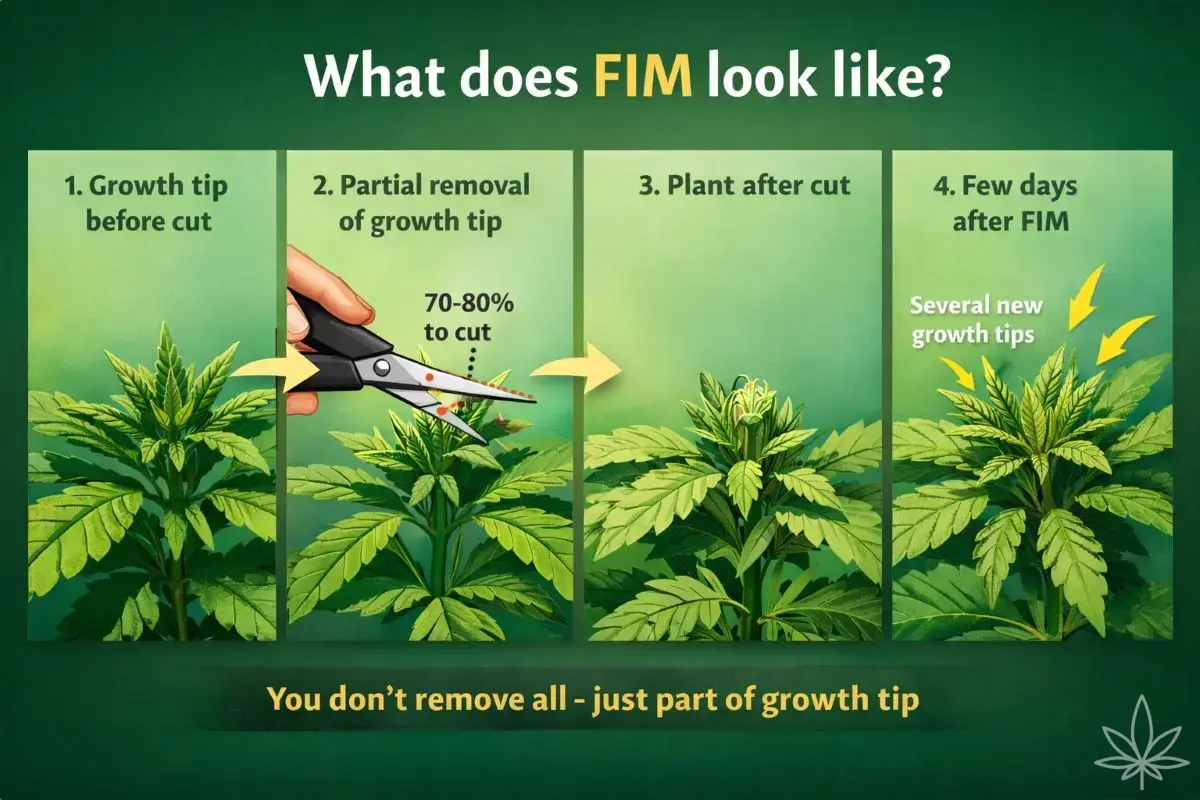
The name FIM comes from a growers’ joke and in practice means a technique in which you do not remove the entire growth tip, but only cut it partially. Instead of cutting the top cleanly as with topping, you leave part of the youngest growth behind. In theory, this is supposed to make the plant not so much “hand over power” to two new leaders, but rather push out several new growth points from the same area.
And this is exactly where the difference begins.
With topping, the situation is fairly clear: you cut off the main growth tip, so the plant very often builds two new dominant tops. With FIM, the result can be more complex. Sometimes you get three or four new shoots, sometimes two, sometimes something in between. This is not a technique of “precision engineering.” It is more like controlled confusion in the growth zone.
In good hands, that confusion can be very useful. In bad hands, it creates unnecessary chaos.
How Does FIM Differ from Topping in Practice?
At first glance, the difference seems small. Here you cut the top, there you also cut the top. But from the plant’s perspective, it is not the same thing.
Topping is the complete removal of the main growth tip.
FIM is the partial removal of new growth, without completely destroying the entire tip.
The practical effect is also different.
Topping usually:
- gives a more predictable result,
- more often leads to two new main tops,
- is easier to plan for further LST or ScrOG.
FIM more often:
- gives a more irregular, but potentially richer development of the top,
- can create more new growth points,
- requires a better eye for further organizing the crown.
If I had to say it in grower language: topping is a hammer, FIM is more of a multitool. And that is exactly why topping is usually easier for beginners, and FIM more interesting for those who already like to play with plant structure.
Why Do Beginners So Often Do FIM Wrong?
Because FIM is a technique that, by definition, is based on a cut that is “not completely” done. And that means it is very easy to overshoot in one direction or the other.
If you cut too low, you do a classic topping.
If you cut too high, the plant may almost ignore the procedure or respond with a random kind of regrowth.
If you cut a plant that still has no vigor, then it does not matter whether it was FIM, topping, or the grower’s finger — the effect will be weak.
The second problem is psychological. Many people imagine that FIM is some kind of “clever technique for insiders,” so they begin experimenting with cutting before learning the basics of reading the plant. And the truth is that first you have to be able to recognize a healthy, well-started plant and understand what an active growth zone looks like. Without that, FIM becomes a movement done blindly.
When Does FIM Make Sense?
FIM makes sense when you want to get a more developed top structure without a very rigid, predictable division into two leading tops. This technique fits well in situations where:
you have some time in vegetative growth,
the plant is healthy and growing quickly,
you plan to continue shaping its form,
and you do not need a pharmacy-level even result from the very first cut.
This is important: FIM is not a technique for a grower who wants to “sort it out quickly and cleanly.” Topping is more practical in that sense. FIM is more often chosen by those who like working with the plant a little more actively and who already plan further bending, shoot selection, or a screen later anyway.
In short: FIM makes sense when you are not afraid of a somewhat more organic, less textbook development of the crown.
What Is the Best Moment for FIM?
Just like with topping, the plant has to already be in decent condition. You do not do FIM on a seedling that is still fighting for life, or on a plant after watering mistakes, deficiencies, or just after transplanting.
Most often, the sensible moment comes when the plant already has several clear nodes, active side growth, and a healthy, dynamic top. This is not an operation based on numbers, but on condition. In practice, it usually means a plant that has already entered vegetative growth properly, but has not yet had time to shoot up too much.
If you do FIM too early, you may only delay the plant at the moment it was just building momentum. If you do it too late, you bring chaos into the crown that will be harder to arrange.
What Does a Proper FIM Cut Look Like?
Here I will not pretend that this can be described in one magical sentence, because that is exactly the whole charm and problem of this technique. In FIM, you do not cut off the entire top, but part of the youngest, fresh growth tissue. So you are not cutting low under the top itself like in topping, but you are also not just snipping symbolically at the very tips.
The point is to damage and partially remove the active new growth while still leaving part of that zone alive. That is exactly why FIM so often comes out differently — because one millimeter in one direction and the effect already changes.
The most important rules are simple:
- cut with a clean, sharp tool,
- cut a healthy plant, not one that is barely alive,
- do not do it blindly on a plant you are afraid even to touch,
- and accept that FIM does not give as predictable a result as topping.
That is not a flaw. It is simply a feature of this technique.
What Does a Successful FIM Look Like After a Few Days?
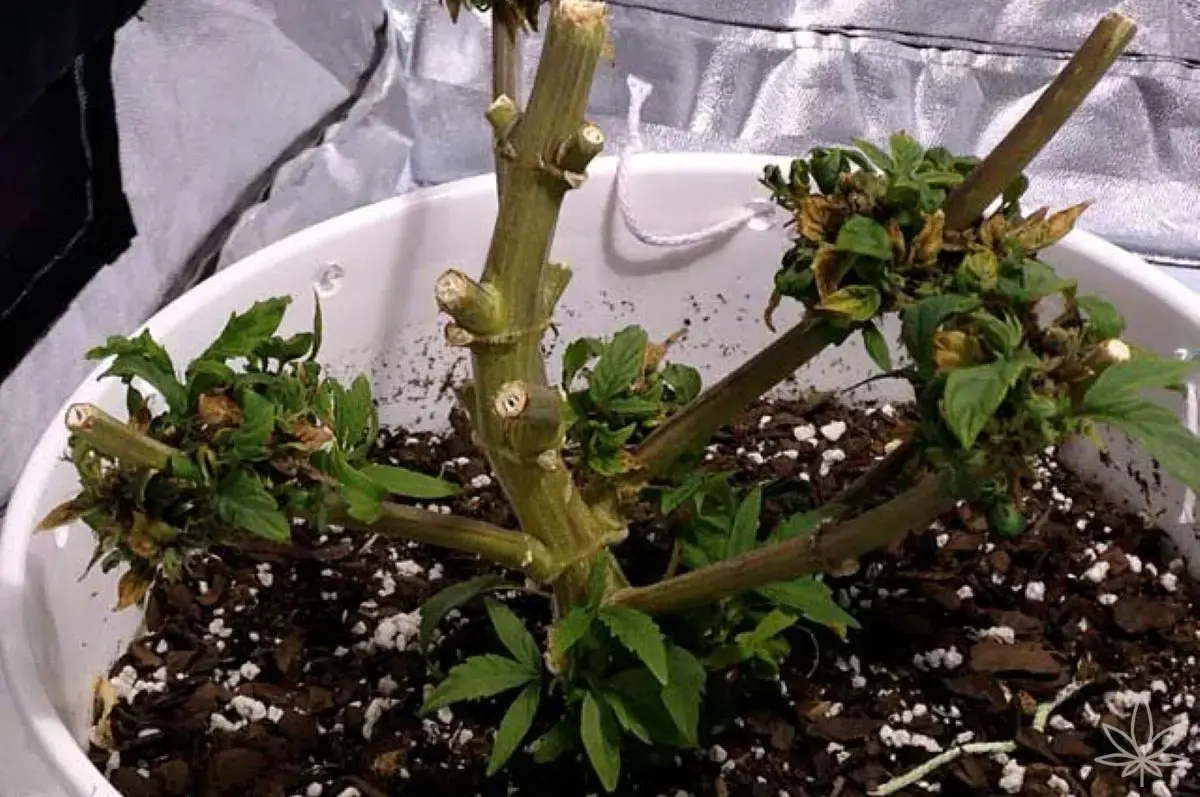
After a successful FIM, the plant usually slows down for a moment, and then starts very interestingly expanding the area around the cut. Instead of one clear division into two new tops, several active growth points appear in the area of the damaged tip. The crown becomes denser, more multidirectional, and begins requiring the grower to consciously guide it further.
This is important: a successful FIM does not have to look “aesthetic” right away. Sometimes, for a few days, everything looks a little strange before the plant shows how it will really divide its energy. And that is exactly why many beginners panic too quickly. They look after two days and think they broke something because they do not see perfect symmetry.
And FIM often does not give perfect symmetry. It gives the potential to build a more complex top of the plant. The grower then has to organize that potential.
FIM and Photoperiods – a Good Combination
Just like topping, FIM feels best with photoperiod plants. The reason is simple: you control the time and can calmly let the plant bounce back after the procedure. If it needs a few extra days, it simply gets them. It is not being chased by the biological clock of an autoflower.
That means that with photoperiods, FIM can be a really interesting alternative to topping. Especially when the grower wants to build a more expanded structure under a screen or a wide horizontal training setup. A photoperiod forgives more, gives time for correction, and lets you organize the crown after a more “artistic” cut.
In practice, it is exactly with photoperiods that FIM makes the most sense as a conscious technique, not an experiment.
FIM and Autoflowers – Here the Risk Grows Even More
If you need to be careful with topping autoflowers, then with FIM you need to be careful twice as much. Why? Because the technique itself is less predictable. And the autoflower does not give you as much time for corrections as a photoperiod anyway.
That means that if you do FIM on an auto too early, too late, too deep, or on a plant without vigor, you can lose valuable days and get an effect that neither improves structure nor increases yield potential. It simply creates stress and mess.
Does that mean that FIM on autoflowers never makes sense? No. But it is definitely not a technique “for the first time.” If someone is only learning plant training, an autoflower will usually reward gentle LST better than playing with half-cuts at the top.
To say it most honestly: if you have to ask whether to do FIM on an auto, then it is probably not the time yet.
What Is FIM Best Combined With?
FIM combines very well with further shaping of the crown. The technique itself gives the plant an impulse to build out the top, but if you do nothing with that afterward, you can end up with a dense knot of growth that looks interesting, but does not necessarily work best under the light.
That is why after FIM, the following often works very well:
- light LST, to stretch the new tops,
- organizing the direction of shoot growth,
- later, sensible cleaning of the lower part of the plant,
- and possibly ScrOG, if you want to spread the crown widely across the screen.
This is actually one of the most important things to understand: FIM does not finish the work, it opens it. After it, you usually have to guide the plant more actively than after ordinary topping.
When Is It Better to Choose Topping Instead of FIM?
In most situations where you care about simplicity, predictability, and a clean effect. If you have limited time, want to build a simple, logical structure, and are not interested in experimenting with more temperamental top behavior, topping will usually be the better choice.
Topping wins when:
- you want to level the plant quickly,
- you are planning simple LST,
- you are building a base for a classic ScrOG,
- you do not want to guess how the plant will grow back,
- or you are simply just learning how to cut.
FIM wins when:
- you have a little more time,
- you like more active crown shaping,
- you accept a less predictable result,
- and you want to play with the structure more than with classic topping.
This is not one technique at war with the other. It is a matter of matching the tool to the grower’s style.
The Most Common Mistakes with FIM
The first mistake is doing FIM without understanding the difference between it and topping. Someone simply “cuts something” in the top and hopes it will work out. Sometimes it will. But that still does not mean there was any control in it.
The second mistake is doing FIM on a plant that is already stressed. Every cutting technique works best on a plant in good shape. You will not help a weak plant with a “clever” cut.
The third mistake is throwing in everything at once: FIM, bending, defoliation, changing feed, changing lamp height. Then it is impossible to know what actually caused the plant’s reaction.
The fourth mistake is judging the result too quickly. FIM needs a moment of patience. If a grower starts poking at it again after two days because “it does not look ideal,” they usually take away their own chance to see the real effect.
Does FIM Increase Yield?
Just like topping — not by itself. FIM does not produce grams in a magical way. It can increase the potential for better use of light and space, but only if the plant is healthy and the grower knows how to organize that effect afterward.
A well-done FIM can help build a more developed crown and more active tops. A poorly done FIM can simply make a mess at the top of the plant and extend vegetative growth without any meaningful gain.
As always indoors, yield does not come from one trick. It comes from the sum of decisions: light, climate, roots, watering, pH, training, and consistency. FIM can be part of that puzzle. Not its magical shortcut.
FIM is an interesting, valuable technique, but not for every grower and not for every grow. It works best when you know that you want a more complex top structure than after classic topping and you have time to manage that structure afterward.
If you value predictability and simplicity — topping will usually win.
If you like more conscious crown shaping and accept a bit more unpredictability — FIM can be a very sensible tool.
The most important thing, however, is not to do FIM because it sounds “more pro.” In growing, the more complicated technique does not win. The one that wins is the one you know how to do well and carry through to the end.