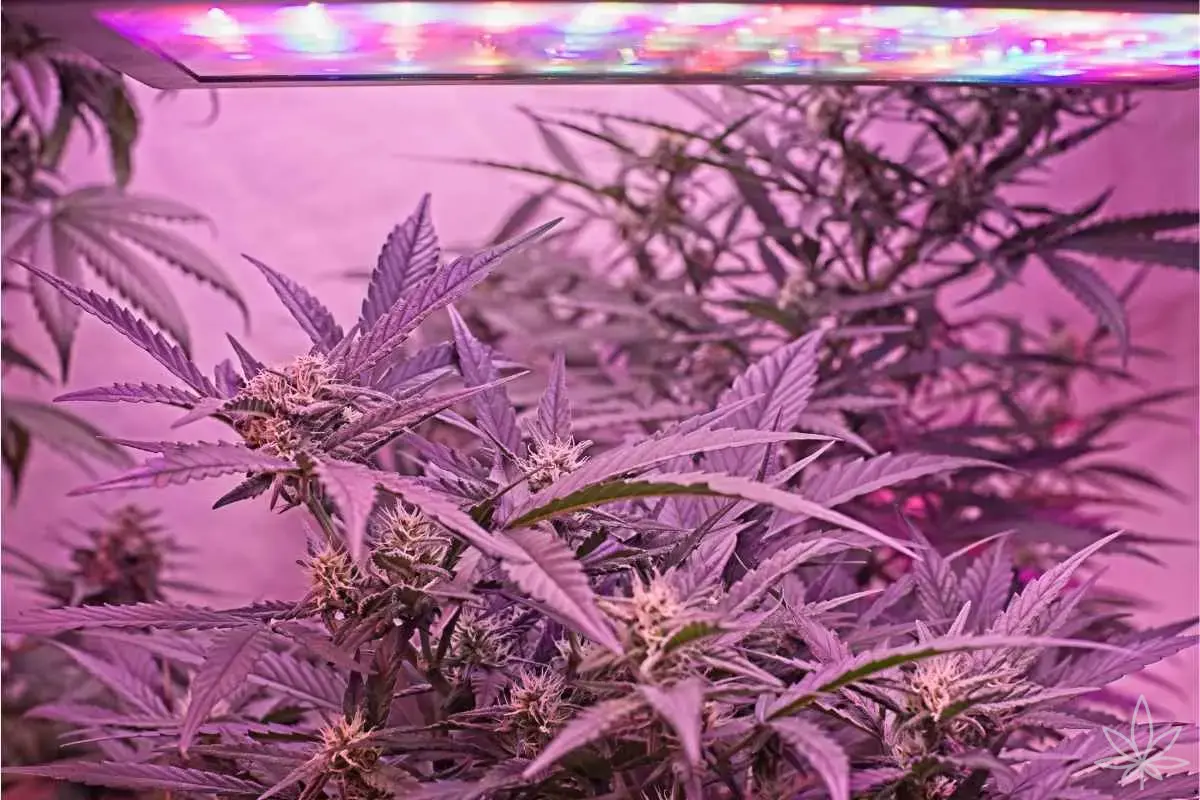
Five or six years ago, most growers were switching from 600W HPS to their first serious 480–600W LED panels and were blown away by the results. Today the market looks completely different. Manufacturers are pushing 800W, 1000W, even 1200W fixtures “for 1 m².” Product pages are packed with big numbers: 3.0 µmol/J, 2800 µmol/s PPF, commercial grade, maximum yield technology.
And sooner or later the question appears:
If I don’t run 1000W per square meter in 2026, can I even pull a top-tier yield?
Let’s peel away the marketing layer and talk about what actually matters in a grow room.
Where Did “1000W per Square Meter” Come From?
It didn’t appear out of nowhere. It’s the result of several things happening at once:
- LEDs became much more efficient (2.7–3.2 µmol/J in top models).
- Growers started measuring PPFD instead of just looking at watts.
- More people began experimenting with CO₂ supplementation.
- Marketing shifted toward “more power = more yield.”
Back in the day, a 600W HPS over 1 m² delivered around 900–1100 µmol/m²/s in the center and much less at the edges. Modern 1000W LEDs can deliver a very even 1200–1500 µmol/m²/s across the entire canopy.
Sounds impressive. But the plant has biological limits.
How Much Light Can the Plant Actually Use?
Here we need to talk about two key concepts: PPFD and DLI.
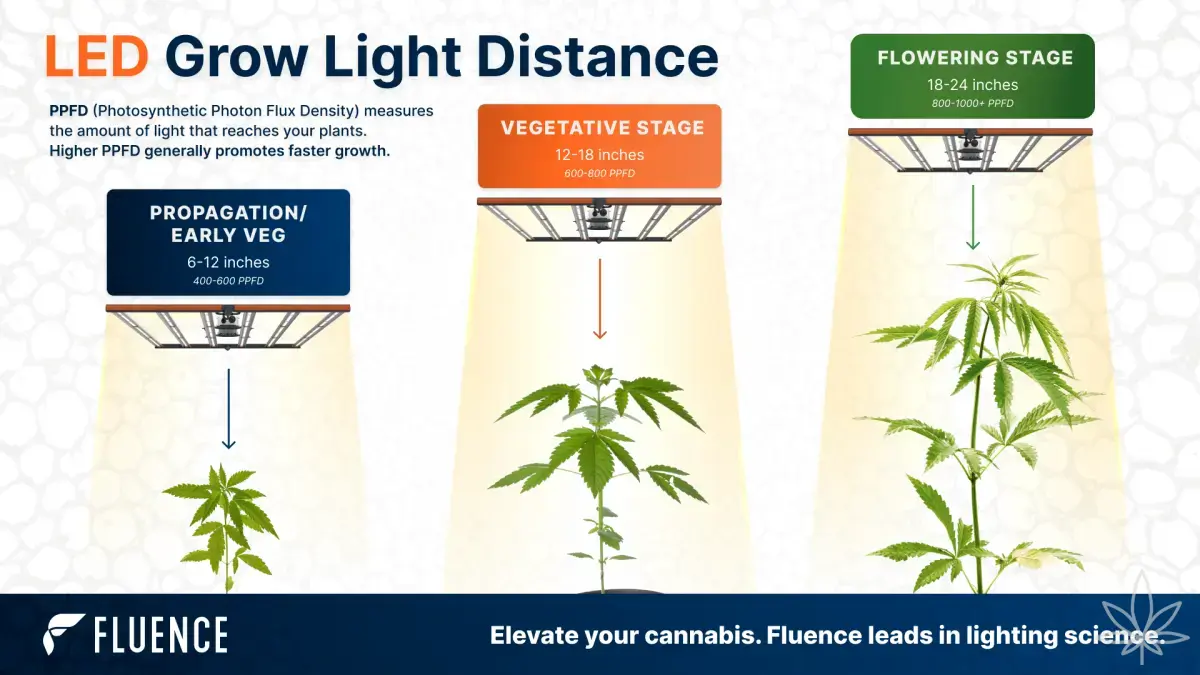
PPFD (Photosynthetic Photon Flux Density) tells us how many micromoles of photons hit one square meter every second.
DLI (Daily Light Integral) represents the total amount of light the plant receives per day.
For indoor cannabis without added CO₂:
- 700–900 µmol/m²/s → very strong range
- 900–1000 µmol/m²/s → upper edge of efficiency
- Above 1000 µmol/m²/s → often diminishing returns
With CO₂ enrichment (1200–1500 ppm):
- 1000–1200 µmol/m²/s → optimal
- 1200–1400 µmol/m²/s → beneficial in ideal conditions
- 1500+ → extreme, requires a dialed-in environment
Here’s the key point: without CO₂ and perfectly managed VPD, 1000W per 1 m² often does not increase yield proportionally to the extra electricity consumed.
More Light = More Yield?
Yes… but only up to a point.
The plant’s response curve to light is not linear. Initially, increasing light dramatically boosts biomass production. Then gains begin to shrink. Eventually, you hit a wall where the plant simply cannot process more energy because:
- CO₂ becomes the limiting factor,
- leaf temperature is too high,
- the root system cannot keep up with nutrient transport,
- photosynthetic enzymes are already working at maximum capacity.
At that stage, adding watts creates more “sunburn” than real dry weight gain.
Real-World Scenarios – 1 m² Under the Microscope
600W LED
A well-designed 600W LED (2.7–3.0 µmol/J) delivers a stable 800–1000 µmol/m²/s.
Without CO₂, this is fully sufficient.
In a well-run grow, you can realistically target 500–700 g of dry flower per 1 m², depending on genetics and skill level.
For roughly 80% of home growers, this is the sweet spot.
800W LED
Now you’re in the 1000–1200 µmol/m²/s range.
Without CO₂, this is already pushing the limit of efficiency.
With CO₂ and excellent climate control, you’re entering serious optimization territory.
Yield may increase by 5–15%, but electricity consumption jumps by roughly 30% compared to 600W.
Does the math justify it? That depends on your goals.
1000W LED
Now we’re talking 1200–1500 µmol/m²/s.
Without CO₂, this is often overkill.
With CO₂, air conditioning, perfectly dialed VPD, and stable fertigation — yes, you can push the limits.
But this is already semi-commercial territory.
Mistakes become expensive: burnt tops, foxtailing, light stress.
Overlighting – The Underdiscussed Issue
Too much light can:
- increase transpiration to stress levels,
- cause apparent deficiencies (nutrient lockout symptoms),
- accelerate terpene degradation,
- reduce resin quality if flower surface temperatures get too high.
Interestingly, some growers report better aroma and terpene preservation at 850–950 µmol/m²/s compared to 1300.
More light does not automatically mean better quality.
The Real Key Factor: Environment, Not Watts
You can own a 1000W LED.
If:
- your VPD is unstable,
- air circulation is poor,
- leaf temperature exceeds 30°C,
- root zone sits at 18°C,
then a properly dialed 600W setup will outperform a chaotic 1000W system.
Light is the engine. But without proper fuel and cooling, engines overheat.
What About Energy Efficiency?
Let’s run rough numbers:
1000W × 12 hours × 30 days = 360 kWh per month during flowering.
At 0.30 EUR/kWh, that’s 108 EUR monthly for the light alone.
600W under the same schedule = about 65 EUR.
That’s a 43 EUR monthly difference.
Will the extra 5–10% yield cover that cost? That’s math — not marketing.
So What Makes Sense in 2026?
For most indoor growers without CO₂:
The optimal range is 600–800W of high-quality LED per 1 m².
Aim for 850–1000 µmol/m²/s evenly distributed across the canopy.
1000W makes sense if:
- you run CO₂,
- you have full climate control,
- you understand fertigation management,
- you calculate ROI like a small business.
Marketing sells watts.
Experience sells stability.
If your budget is limited, it’s better to buy a highly efficient 600–700W fixture than a cheap 1000W unit with aggressive advertising claims.
Indoor growing is not about how much light you can blast at the plant.
It’s about how much the plant can actually use efficiently.