If you’ve ever thought about running a truly “undetectable” grow — one where the smell gives absolutely nothing away — you are in the perfect place. Ozone has been a mythic topic among growers for years, often described as the “ultimate weapon” against cannabis odor. Some say it’s a total game-changer, others call it a deadly gas that destroys everything in its path… including terpenes, plants and even the grower if used incorrectly. Ozone generators are marketed as miracle devices, but as usual, the truth lies somewhere in the middle. In this article I’ll explain how ozone really works, when it makes sense to use it, when it becomes dangerous, what its limitations are, and how to use it in stealth grow setups without harming your health, your plants or your final aroma.
What Ozone Actually Is — and Why It Works on Odor
Ozone (O₃) is a highly reactive form of oxygen that aggressively reacts with organic molecules — including the volatile terpenes responsible for the smell of cannabis.
When terpenes meet ozone:
- they oxidize,
- their molecular structure breaks down,
- the smell becomes neutralized.
This is why ozone is widely used for cleaning smoke-damaged rooms, hotel sanitation, and industrial odor removal.
In theory — sounds perfect for growers.
In practice — it’s far more complicated.
Ozone vs Plants: What Happens If Ozone Enters the Growroom
This is the most important point in the entire article:
Ozone MUST NOT enter the growroom or the grow tent.
Why?
- Ozone oxidizes the lipids in leaf tissue.
- The plant responds as if exposed to air pollution — it closes stomata, becomes stressed, and slows growth.
- High ozone levels cause tiny necrotic spots on leaves.
- Even higher levels kill plant tissue outright.
And even worse:
Ozone destroys terpenes.
Meaning: it not only kills the smell escaping the growroom but also destroys the aroma of your flowers if any ozone makes it back inside.
If you want fragrant, terpene-rich buds — keep ozone far away from the plants.
How to Use Ozone Safely (Without Damaging Your Grow)
There are only two safe configurations:
1. Ozone Outside the Growroom: In a Room Where Exhaust Air Is Released
This is the only method widely recommended by experienced growers.
Setup looks like this:
- Air leaves the tent through a carbon filter.
- This filtered air enters a closed room (closet, bathroom, storage room, utility room).
- An ozone generator operates in that external room, neutralizing any remaining odor.
Advantages:
- ozone never touches the plants,
- the carbon filter performs 90% of the work; ozone handles the remaining 10%,
- extremely high stealth level without harming the crop,
- ozone naturally decays back into oxygen in 15–40 minutes.
This is why growers often say:
“Ozone is the ultimate odor backup.”
2. Ozone in the Ventilation Duct (Inline System)
This method is semi-professional and requires the right hardware:
- the ozone generator sits inside the exhaust duct,
- ozone mixes with the outgoing air,
- terpene breakdown happens before the air exits the building.
Important considerations:
- you need 3–5 meters of ducting to allow full reaction time,
- ozone must be fully neutralized before the air reaches living areas,
- ducting must be ozone-resistant (most is, but not all).
Ozone and Human Health — What Growers Must Not Ignore
Ozone is not an air freshener.
Inhaled ozone is toxic.
Possible effects:
- irritation of the respiratory system,
- coughing,
- chest tightness,
- headaches,
- at high levels — damage to lung tissue.
Rule #1:
Never stay in a room while an ozone generator is operating.
Rule #2:
Enter only 30–40 minutes after the machine turns off.
Rule #3:
Keep pets away, especially birds and cats.
When Ozone Makes Sense in a Stealth Grow — and When It Doesn’t
Ozone makes sense if:
- you live in an apartment and need absolute odor security,
- your exhaust air enters a shared area (basement, stairwell),
- your carbon filter removes most but not all of the smell,
- you grow very aromatic strains (GMO, Skunk, Chemdog),
- you run multi-layer setups with intense odor output,
- you want a backup solution during humidity spikes.
Ozone does NOT make sense if:
- you plan to run it inside the grow tent,
- you use a cheap generator with unstable output,
- you try to replace a carbon filter with ozone,
- you cannot isolate the ozone-treated room,
- people sensitive to ozone are inside the home.
Carbon Filter + Ozone = The Ultimate Stealth Combo
This is the gold standard of stealth growing:
- High-quality carbon filter
— ideally with RC-48 grade carbon. - Proper airflow match
— filters don’t work if the fan is too strong. - Negative pressure inside the tent
— guarantees no odor leaks. - Ozone outside the growroom
— eliminates any remaining traces.
Result:
A completely undetectable growroom, even if someone opens the wrong door at the wrong moment.
Using Ozone in the Home (Outside the Grow) — Does It Work?
Yes — if used correctly.
Growers use ozone in:
- hallways,
- bathrooms,
- utility rooms,
- buffer rooms before the growroom.
Typical treatment:
- 10–20 minutes for small rooms,
- 20–30 minutes for larger spaces,
- followed by a 30-minute decay period.
Important:
Never ozonate bedrooms, kitchens or rooms with food.
Ozone is extremely effective — but equally aggressive.
Does Ozone Damage Grow Equipment?
Yes — in some cases.
If ozone touches:
- soft plastics,
- rubber seals,
- acoustic foam,
- low-quality cable insulation,
it may accelerate degradation.
Therefore ozone generators must always stay away from:
- grow tents,
- fans and filters,
- controllers,
- LED lights,
- humidifiers.
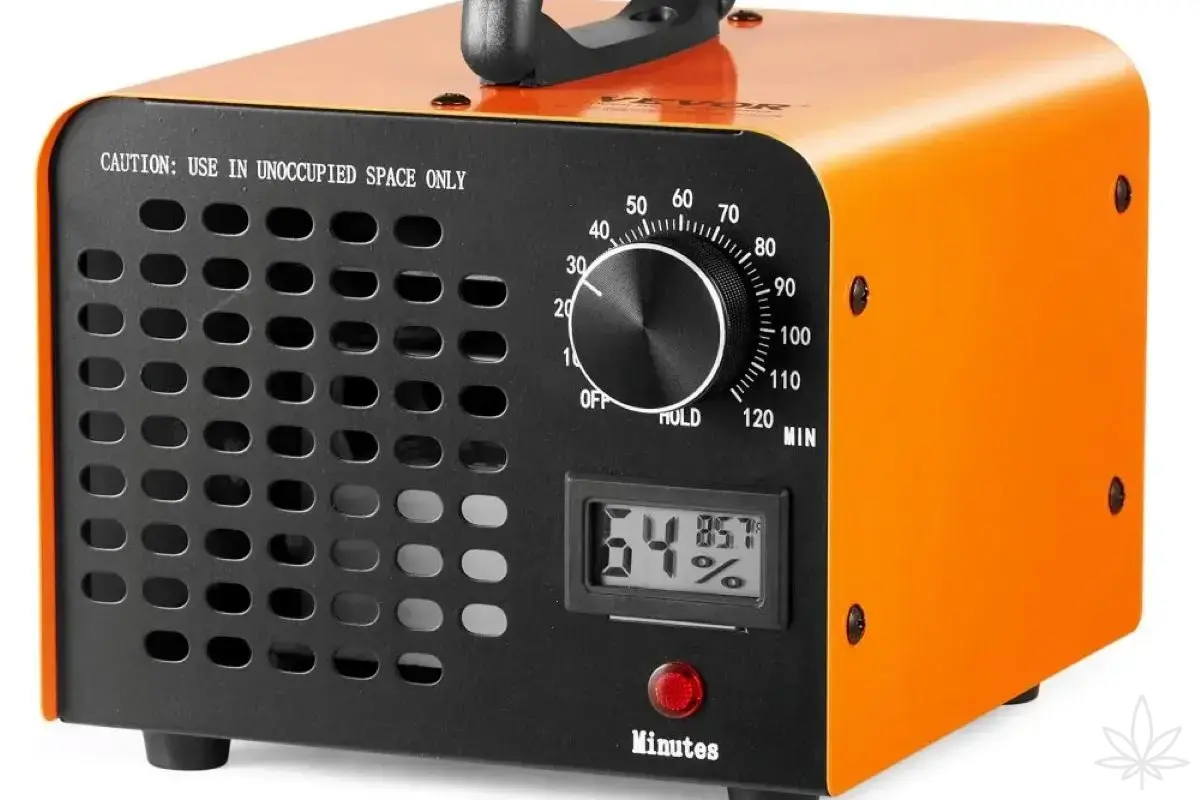
Ozone equipment belongs outside the grow system.
How Much Does It Cost?
Typical price ranges:
- small room ozonators: 30–60 EUR,
- medium units: 60–120 EUR,
- inline/duct professional units: 120–250 EUR.
Avoid the cheapest ones — they often produce unstable amounts of ozone and are unsafe.
Ozone Is Powerful — but Requires Respect
Ozone can make a growroom virtually undetectable, but only when used properly:
- never inside the growroom,
- only outside,
- only together with a carbon filter,
- only in sealed rooms,
- only when no humans or animals are present.
Used responsibly — ozone is one of the strongest tools in stealth growing.
Used recklessly — it can destroy your plants, aroma, equipment and lungs.