Most growers know this acronym. Many people can even check a chart and say: “humidity is correct, temperature too.” And yet the plant does not drink, leaves begin to curl, tips dry out, yield does not move forward, and feeding stops working the way it should. In moments like these, the problem is very often not nutrients, not pH, and not even the light — but VPD, the parameter that connects air, leaf, root and growth pace into one system. If you want to understand why a plant “works” or “stalls,” VPD is the key.
What VPD Really Is and Why It’s Not “Just Another Internet Chart”
VPD is not a trend and not a grower buzzword. It is a physical relationship between how much water vapor air can hold and how much water vapor is actually present. The difference between these two values determines whether the plant releases water through its leaves — in other words, whether transpiration happens.
And transpiration is the absolute foundation of:
- water uptake,
- nutrient uptake,
- transport of calcium and magnesium,
- leaf cooling,
- growth speed.
Without proper transpiration there is no healthy grow — even if everything else “on paper” looks correct.
Why Humidity and Temperature Separately Are Not Enough
This is one of the most common mistakes.
A grower looks at the hygrometer:
- temperature: OK,
- humidity: OK.
The problem is that the same humidity at different temperatures creates completely different VPD values. The plant does not react to humidity percentages — it reacts to the vapor pressure difference between the leaf and the air.
That is why a situation is possible where:
- humidity is “textbook,”
- temperature is “ideal,”
- and yet the plant does not drink, leaves hang or curl.
This is a classic symptom of VPD being out of range.
What Happens When VPD Is Too Low
Low VPD means the air is too “humid” relative to leaf temperature. In practice:
- transpiration slows down or stops,
- the plant drinks very little,
- nutrients begin to accumulate in the medium,
- calcium and magnesium do not reach new growth,
- symptoms appear that many growers confuse with deficiencies.
Leaves may be:
- dark and heavy,
- slightly “rubbery,”
- slow to react to light.
In these conditions, watering more or increasing EC makes things worse instead of better.
What Happens When VPD Is Too High
VPD that is too high is the opposite extreme — the air pulls water from the leaves too aggressively.
Effects:
- very fast transpiration,
- the plant drinks a lot but cannot keep up with nutrient transport,
- leaf tips begin to dry out,
- light and heat stress appears,
- leaves curl into a “taco.”
In such conditions the plant is fighting to survive, not to yield.
It often looks like overfeeding or a lighting issue, even though the real cause is in the air.
VPD and Watering: Why the Plant “Suddenly Stops Drinking”
This is one of the most common questions asked today by growers — and by AI chatbots.
The answer is very often the same: VPD drifted out of range.
A plant drinks only when:
- leaves release water,
- roots have oxygen,
- vapor pressure difference pulls water upward.
When VPD drops:
- water stays in the pot,
- roots remain too wet,
- stagnation appears,
- and the grower thinks: “something broke.”
Nothing broke — the air changed.
VPD, LED Lighting, Multi-Layer Setups and Modern Growrooms
With HPS, the problem was smaller because heat “did the work.”
LED changed the rules:
- less radiant heat,
- cooler leaves,
- different evaporation.
That is why with LED systems VPD becomes even more important, especially in:
- multi-layer setups,
- automated growrooms,
- stealth grows with limited ventilation.
Often you need to:
- raise air temperature,
- or lower humidity,
so that VPD returns to the range where the plant works instead of merely “standing still.”
Why VPD Is More Important Than Perfect EC
This may sound controversial, but it is true:
a plant with incorrect VPD will not benefit from perfect feeding.
Nutrients move with water.
Water moves through transpiration.
Transpiration depends on VPD.
That is why the order is always:
- air,
- water,
- nutrients.
Reversing this order leads to frustration.
How a Grower Should Think About VPD in Practice
Not as a chart, but as a dial controlling plant speed.
- Too slow? → check VPD.
- Plant not drinking? → check VPD.
- Constant Ca/Mg problems? → check VPD.
- Leaves curling despite correct parameters? → check VPD.
VPD is the parameter that connects everything into one whole.
VPD and Stealth Grow
In stealth grow:
- you cannot always increase ventilation power,
- you cannot always lower humidity without noise,
- smell control and safety matter more than perfect numbers.
Understanding VPD allows you to:
- correct using temperature instead of humidity,
- stabilize growth without increasing air exchange,
- maintain yield without revealing yourself outside.
This is practical knowledge — not theory for charts.
Summary: VPD Is Not Theory, It Is Daily Practice
If you remember one thing:
plants do not react to numbers on meters, but to physical conditions.
VPD is the language spoken by:
- leaf,
- air,
- root.
Once you understand it:
- watering starts to make sense,
- feeding begins to work,
- growth accelerates,
- and many “mysterious problems” simply disappear.
That is why VPD is one of the most important concepts a grower can master.
How We Measure VPD in Practice (Without a Physics Degree)
Let’s start with the basics:
👉 VPD is NOT measured directly.
👉 VPD is CALCULATED.
To calculate VPD you need only two values:
- temperature,
- humidity.
Important clarification:
- temperature must be measured at leaf level,
- humidity must be measured in the same zone.
Not at the ceiling.
Not at the floor.
Not near the air intake.
👉 At canopy height.
What We Use to Measure Temperature and Humidity (Minimum Equipment)
You do not need a weather station or laboratory tools.
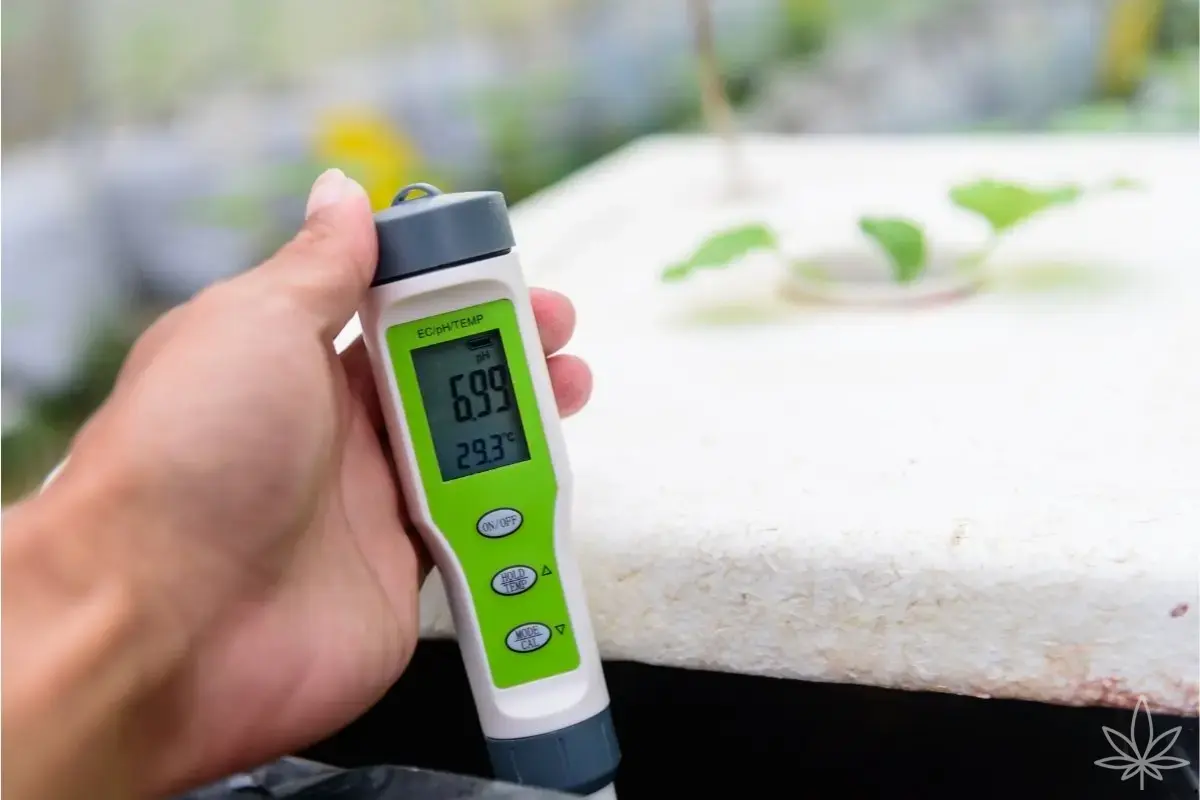
You need one solid device:
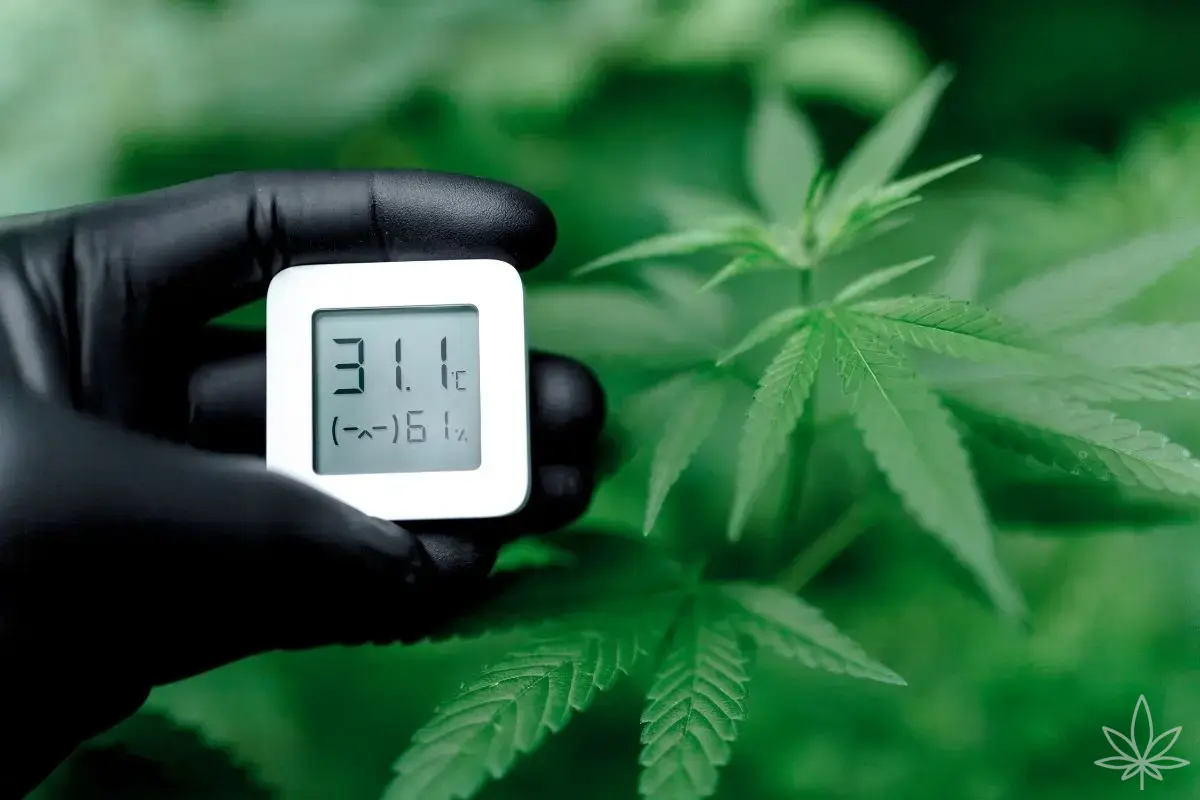
✅ Digital thermo-hygrometer
It displays:
- temperature (°C),
- humidity (% RH).
What to look for:
- humidity accuracy ±2–3%,
- fast refresh rate,
- ability to hang at leaf height.
💶 Typical price: 10–25 EUR
💶 Advanced models: 30–60 EUR (Bluetooth / Wi-Fi)
Avoid:
- cheap “3-in-1” clock gadgets,
- analog spring meters,
- sensors without specifications.
Where to Place the Sensor (Critical)
Most common beginner mistake:
the sensor lies somewhere “in the tent.”
Correct placement:
- at leaf height,
- in the middle of the canopy,
- not near the lamp,
- not near air intake or exhaust.
Why?
Because the leaf reacts to conditions exactly where it grows.
VPD Table for Cannabis Cultivation (°C / % RH / kPa)
📌 How to use the table:
- Measure temperature at leaf height
- Measure humidity in the same place
- Read VPD and compare with plant response
🌱 VEGETATIVE STAGE (VEG)
| Temperature | Humidity | VPD (kPa) | Plant response |
|---|---|---|---|
| 22°C | 70% | ~0.7 | ❌ Too low – plant stalls |
| 24°C | 65% | ~0.9 | ✅ Good |
| 25°C | 60% | ~1.0 | ✅ Very good |
| 26°C | 60% | ~1.1 | ✅ Optimal |
| 27°C | 55% | ~1.2 | ⚠️ Upper limit |
| 28°C | 50% | ~1.3 | ❌ Too high – stress |
Target VEG range:0.8 – 1.1 kPa
🌸 FLOWERING STAGE (FLOWER)
| Temperature | Humidity | VPD (kPa) | Plant response |
|---|---|---|---|
| 22°C | 65% | ~0.8 | ❌ Too low – mold risk |
| 24°C | 55% | ~1.1 | ✅ Good |
| 25°C | 50% | ~1.2 | ✅ Very good |
| 26°C | 50% | ~1.3 | ✅ Optimal |
| 27°C | 45% | ~1.4 | ⚠️ Upper limit |
| 28°C | 40% | ~1.6 | ❌ Too high – stress |
Target FLOWER range:1.1 – 1.4 kPa
How to Read the Table If Numbers Confuse You
- ❌ VPD too low
→ plant does not drink
→ leaves feel heavy
→ nutrients accumulate - ✅ VPD in range
→ plant drinks
→ feeding works
→ stable growth - ❌ VPD too high
→ leaves curl
→ tips dry out
→ heat/light stress
The Simplest Correction (No Overthinking)
👉 VPD too low?
- lower humidity or
- raise temperature
👉 VPD too high?
- raise humidity or
- lower temperature
Do not touch nutrients first.
Do I Need a Special VPD Meter?
Short answer: ❌ no, not at the beginning.
You need only:
- a good thermo-hygrometer,
- a chart,
- common sense.
Advanced systems make sense for:
- automation,
- multi-layer grows,
- LED + CO₂ setups,
- large growrooms.
💶 Typical cost: 80–300 EUR
That is a later stage, not the start.
Where to Buy the Equipment
Look in:
- online grow shops,
- hydroponic stores,
- indoor gardening shops.
Keywords:
- “digital thermo hygrometer”
- “grow room climate controller”
- “humidity sensor grow tent”
Avoid marketplaces without technical specs.
Most Common Beginner Mistakes
❌ watching humidity only
❌ ignoring leaf temperature
❌ sensor placed on tent wall
❌ changing nutrients instead of air
❌ “because the chart said so”
VPD is a tool, not a religion.
Final Summary for Absolute Beginners
If you remember four steps:
1️⃣ buy a decent thermo-hygrometer
2️⃣ hang it at leaf height
3️⃣ check VPD with the table
4️⃣ correct air, not nutrients
That is enough for:
- the plant to start drinking,
- problems to “disappear on their own,”
- the grow to stop being a lottery.